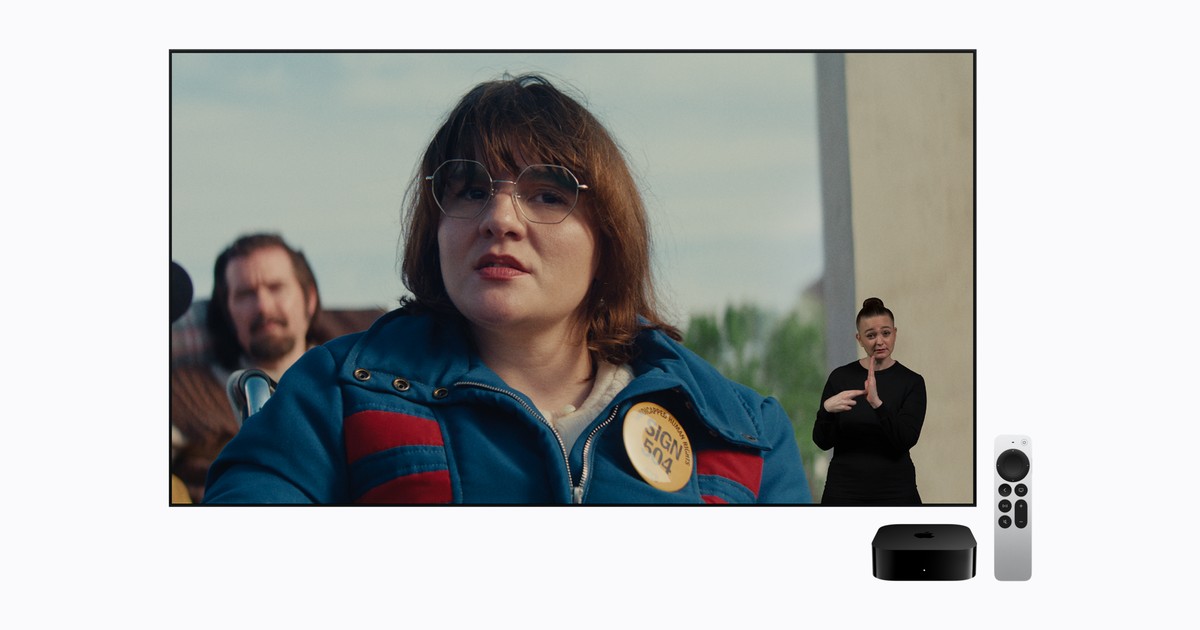
Apple is rolling out a new accessibility option for Apple TV that places a live sign language interpreter directly over the picture for select original films. The feature arrives first with the documentary ‘Being Heumann,’ which tells the story of disability rights activist Judy Heumann and arrives November 13, and the racing drama ‘F1,’ both of which will offer American Sign Language (ASL) and British Sign Language (BSL) interpretation. Apple says ‘Greyhound’ and ‘Way of the Warrior Kid’ will get the same treatment later this year, with more titles planned after that.
How the feature works
According to Apple, each interpretation was built specifically for the film it accompanies rather than applied as a generic overlay, and the company says Deaf and native signers were involved in designing and testing the experience. To use it, viewers need the Apple TV app running on a device updated to iOS 27.2, iPadOS 27.2, macOS 27.2, tvOS 27.2 or visionOS 27.2, as well as on supported third-party devices running the latest version of the app. Once the update is installed, the option has to be switched on inside the Apple TV app’s settings menu before it shows up on supported titles.
Where to find it while watching
On a title that supports the feature, a small hand icon appears alongside other accessibility markers such as audio description. During playback, selecting the Sign Language option above the progress bar lets viewers pick ASL or BSL, and the interpreter then appears in a box in the bottom right corner of the screen, layered over the film itself.

Discovery is still catching up
Right now, with only a handful of titles supporting the feature, finding them should be straightforward. But Apple is already planning ahead: it says the app’s search function will eventually recognize phrases like “with ASL” or “with BSL,” and it plans to build a dedicated collection inside the TV app called “Movies & Shows with American Sign Language” to make these titles easier to browse as the library grows.
Why this matters
Sign language interpretation is a different form of accessibility than captions or subtitles, since it conveys tone, rhythm and emotion in ways text can’t fully replicate, and it’s the primary way many Deaf viewers consume media. Having it baked into original productions, is a meaningful step for a major studio and streaming platform. It also puts a modest spotlight on the software update itself: the feature requires the latest point release across Apple’s platforms, so anyone curious about what else changed in tvOS 27.2 will want to check their software version before looking for the new hand icon.
The bottom line
This is a small but genuine accessibility upgrade rather than a flashy new feature, and its value will depend entirely on how many titles eventually support it. For now, only four Apple Original films are confirmed, so this is more of a pilot than a full library rollout. If Apple keeps adding titles and builds out the promised search and collection tools, it could become a standard expectation for original content rather than a novelty limited to a couple of releases.
Source: Engadget
Where to buy
As an Amazon Associate I earn from qualifying purchases.