Google has introduced Gemini 4 Argon, its newest frontier AI model, and the rollout comes with an unusual twist: instead of opening it up to everyone right away, the company is first handing it to a small group of “trusted cyber defenders.” That’s a notable departure from how most AI labs typically launch their flagship models, and it says a lot about how seriously Google is treating this release.
What Gemini 4 Argon is supposed to do
According to Google DeepMind SVP and chief AI architect Koray Kavukcuoglu, Gemini 4 Argon delivers what the company calls “frontier performance” across three main areas: real-world software engineering, enterprise knowledge work such as legal and finance tasks, and cybersecurity defense. Google says the model is already being used internally, including for large-scale codebase migrations, which gives a hint at how the company expects enterprises to eventually deploy it once wider access opens up.

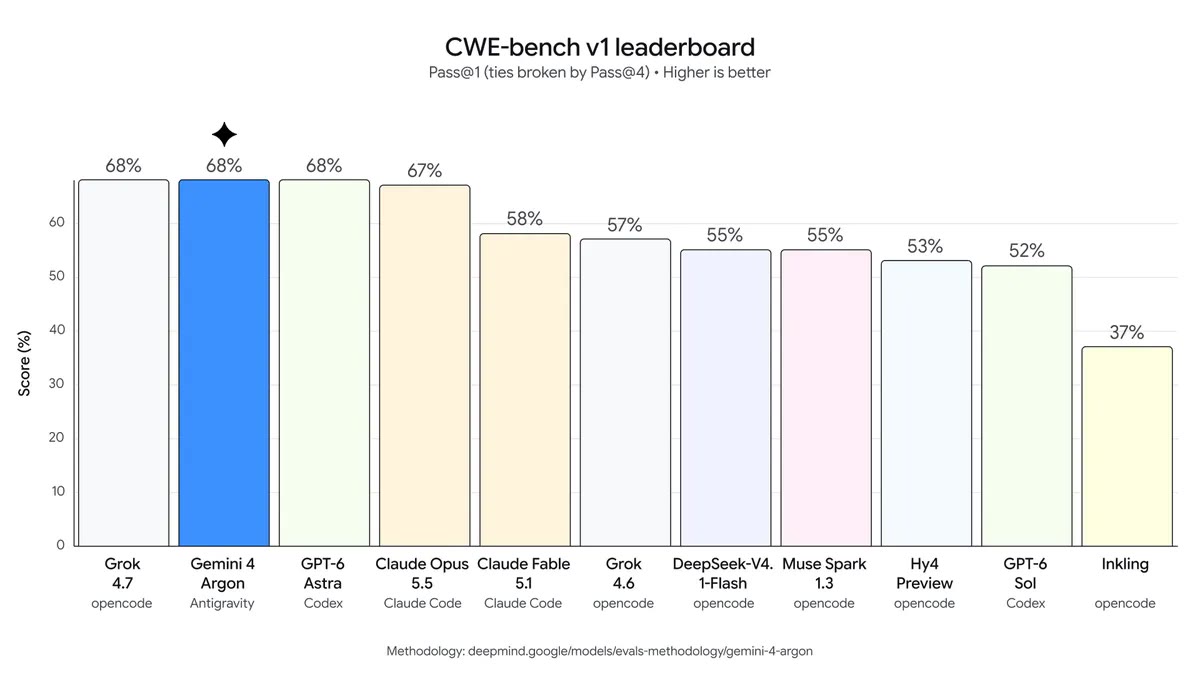
Google also published benchmark comparisons showing Gemini 4 outperforming rival models from OpenAI and Anthropic, echoing benchmark figures that had reportedly leaked online earlier in the week. As with any vendor-supplied benchmark chart, it’s worth taking those claims with a grain of salt until independent testing confirms them.
Why access is being restricted
Rather than a broad public release, Gemini 4 Argon is initially going out only to a limited set of cybersecurity professionals. Kavukcuoglu says Google is working with the U.S. government’s voluntary pre-release model access program while it gradually widens the rollout. Before a broader launch, the company says it plans to reinforce what it calls “critical frontier safeguards,” including protections against misuse, defenses against prompt injection attacks, and ongoing monitoring for signs the model is behaving in unintended ways.
This cautious approach suggests Google sees Gemini 4 Argon’s capabilities, particularly around cybersecurity tasks, as powerful enough to pose real risks if misused before those safeguards are fully in place. It’s a notable example of an AI company explicitly slowing down a launch for safety reasons rather than rushing to match a competitor.
The timing says a lot
Gemini 4 Argon arrived just one day after OpenAI’s DevDay event, where the company unveiled its Dots AI agent alongside GPT-6.1 Sol. OpenAI also confirmed this week that it was holding back a planned GPT-6.1 Astra model over safety concerns, another sign that the leading AI labs are becoming more publicly cautious about what they ship and when. The back-to-back announcements highlight just how competitive the race between Google, OpenAI, and Anthropic has become, with each company racing to claim the performance crown while simultaneously trying to reassure regulators and the public that it isn’t cutting corners on safety.
The launch also comes soon after Kavukcuoglu took over as the new head of DeepMind in August, making Gemini 4 Argon something of a statement release for his tenure.
What this means for everyday users
For now, there’s no consumer-facing product to try. Gemini 4 Argon isn’t showing up in the Gemini app or any Google Workspace tools yet, and the restricted early access is aimed squarely at specialized cybersecurity teams rather than regular users or businesses. Anyone hoping to test it for coding or document work will need to wait for Google’s planned expansion of access, which it hasn’t given a firm timeline for.
The bottom line
Gemini 4 Argon looks like a genuinely capable model on paper, but Google’s decision to gate it behind a small circle of trusted cybersecurity testers is the real story here. It signals that the company views this generation of AI as powerful enough to warrant real caution before a wide release, a stance that puts safety ahead of the usual rush to market. Expect more details, and a broader rollout, in the coming months as Google works through its safeguards.
Source: The Verge